

After the 'Orphan Train' Pulls Away
Tracing the life of an adopted girl named Alice through the records she left behind.

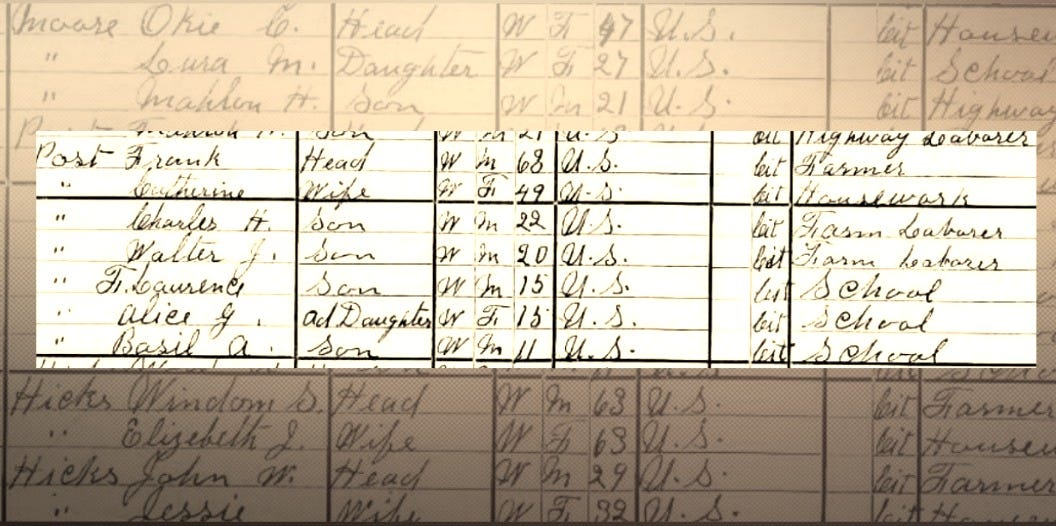
“They had four boys but there was a girl, too,” Aunt Molly said about her father’s family.
“I saw that in the census records – Alice, right? She was adopted?”
“Yes. Alice. My grandparents adopted her from Boston, Massachusetts; it was part of the church looking to place orphans with good Catholic families. The parish priest recommended them.”
The Boston, MA to Colton, NY connection was a bit lost on me. I tumbled down a rabbit hole with no looking glass in sight.
In the later part of the 19th century up until around 1920, a variety of children’s aid organizations looked to move orphans from squalor in cities like Boston and New York to more rural settings. In the best of cases, the children would be assimilated into the home, in the worst, they would be exploited as indentured house servants or farm labor.
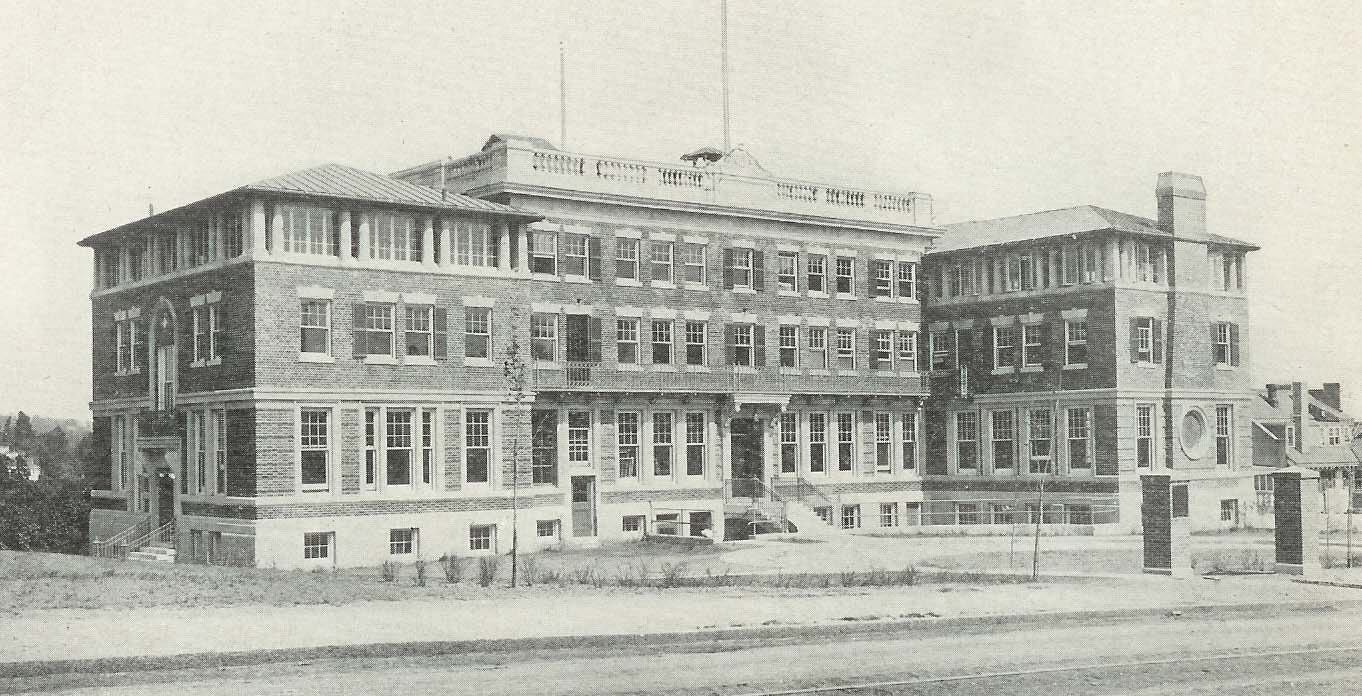
This relocation initiative was dubbed the Orphan Train. The Catholic Church created its own version to combat children being sent to Protestant homes. The diocese of these large cities would reach out to rural parishes, and the priests would choose families like my great grandparents, Catherine and Franklin to partake.
I found Alice G. Post living with my great grandparents in 1915, so I knew she was at least 15 when she was adopted. She was also present in the 1920 census but not in the 1930. Aunt Molly said she went back to Boston to be with her family.
It turns out Alice wasn’t a typical orphan. She was from a family of seven.
Alice Grace grew up on tony Park Street in Taunton, MA, a lively town south of Boston with the nickname of Silver City as it was historic center of the industry. Alice was the youngest of five children, born to Irish and English immigrant parents. She was listed as six months old in the 1900 census.
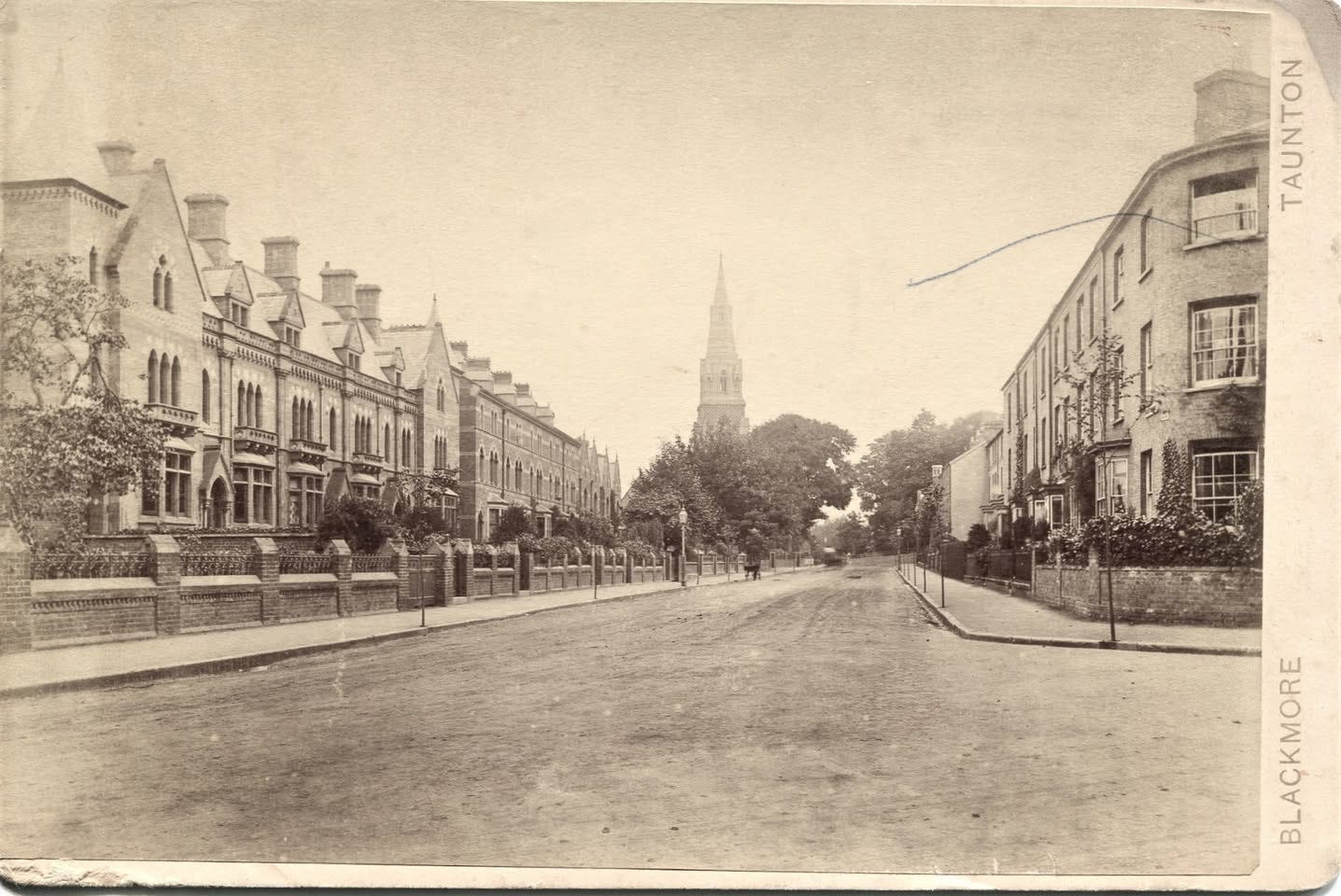
How did she come into the care of my great grandparents?
Mitrial regurgitation is the most common heart valve problem. When the mitral valve doesn’t close properly it makes the heart worker harder. Fairly easy to treat today; in 1901 it was fatal – particularly if a patient was pregnant. Alice’s mother, Mary Ann, died of mitrial regurgitation before Alice was two.
The widower, Edward Grace, originally from Ireland, was a laborer. In examining the city directories, I saw that Edward moved four times between 1901 and 1905. The records tracked his movement – not the children’s. Then he disappeared.
I write about the lives history recorded unevenly – ancestors, adoptees, and what we might infer – after the record ends. New essays arrive Fridays!
In a 1910 census, I found an older sister, Julia, who, at 17, was listed as a servant for a family. She was married by 21.
I never found a census for Mary, the eldest, nor for the middle child, John. But I found a 1911 marriage certificate for her, and a 1918 marriage for him.
Finally, I found the two youngest Grace girls — both living with different families — and categorized as borders. In 1910, Alice, age 10, lived with the McLeod family, while her sister, Sarah,11, lived with the Quigley’s. Sarah was eventually adopted by them.
What happened with the McLeod family? Did they decide they didn’t want a 10-year-old? or did Alice not want to stay? Whatever transpired, Alice was sent to the New York’s North Country sometime after 1910 and adopted before 1915.
The Posts owned a large house on a large working farm. “It was beautifully appointed,” said Aunt Molly. There was no shortage of family members, four boys and Grandma Catherine’s brother Martin. In 1920, the two older boys had moved out, two remained, with one married and having a child.
I wondered if perhaps Alice was considered a servant. But while the census indicated the occupations of the men, none were listed for the three women including Alice. The local papers chronicled that she took part in civic and family events. And yet, sometime after 1920, she left.
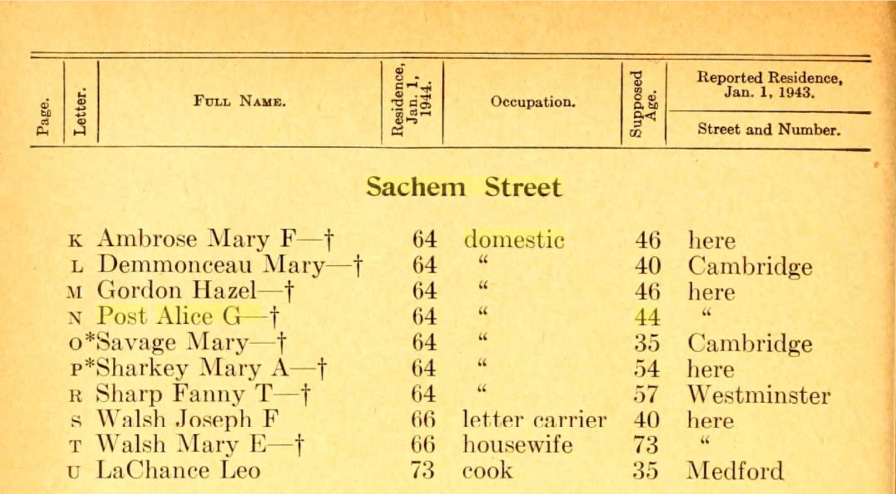
Since the stated reason, according to my aunt, was that Alice returned to Boston to be with family, I thought maybe she would stay with siblings. But that wasn’t the case. Alice, who never married, was listed each year in the city directory — categorized as a Democrat and a maid. She maintained a residence in a rooming house in Watertown for decades.
In an era where “Irish need not apply,” and unskilled women had few employment opportunities, Alice seemingly carved out a life of independence and camaraderie with the women who lived at 64 Sachem Street.
Was it possible she disliked her adopted mother? A 1928 newspaper article suggests otherwise, as it indicated: “Miss Post returned from Boston to visit her mother.” All four Post boys predeceased her – and in each obituary, Alice was listed as a sister.
Maybe, it was as my cousin suggested, that living in the North Country was just two quiet for a girl who had grown up outside of Boston. Certainly, Alice didn’t feel like she belonged, or maybe she didn’t like feeling obligated.
My mother’s middle name was Alice, and in the two years I’ve been filling in my ancestral tree, this was the only Alice I encountered. Was Mom named after Grandpa Charlie’s adopted sister? Would it have mattered to Alice if she knew?
I like to think it would have. To know that even if she left, even if she didn’t stay, even if the records are a patchwork quilt of identities, gaps, and dead ends — she had been remembered.
Isn’t that what all of us want?
I saw a quip from Nate Douglas about genealogy software: “it was built for married people who behaved.”
No truer words! Family secrets are the sand in the gears of research. Let me know about your research adventures.
What I Am Reading
Garth Nix’s Sabriel follows an independent young woman who must save her father trapped in another world. So, ya, the theme is strong bad-ass woman to the rescue.

a year ago…
These days, everyday seems to be protest season. A year ago I took a look at the protest clothes worn by labor organizers and suffragettes, and wondered, did the rigidity of their garments help with their resolve?
We are headed to Florida to visit our son this week and escaping the single digit weather. It’s not much warmer where he is — although the highs in the 40s will feel balmy in comparison.
Have a great week!
xoxo,
diane
I don't think I had understood that the Orphan Train was organized by the Catholics to avoid placement of children in Protestant homes. How interesting to find this "adopted" Alice in your family tree.
Neighbors were very important in my book, “Blooming Hollyhocks,” while doing research I discovered that one of the neighborhood girls had been adopted from an orphan train. However, I decided that wasn’t the story of the book, nor did I know if her descendants knew it. I didn’t include it in my book because I didn’t think it was my place to write about.