

Touch, Adjust, Create: What Sourdough Baking Taught Me About Writing
Creation happens in layers. Building structure, fermenting ideas, and letting both rise in their own time

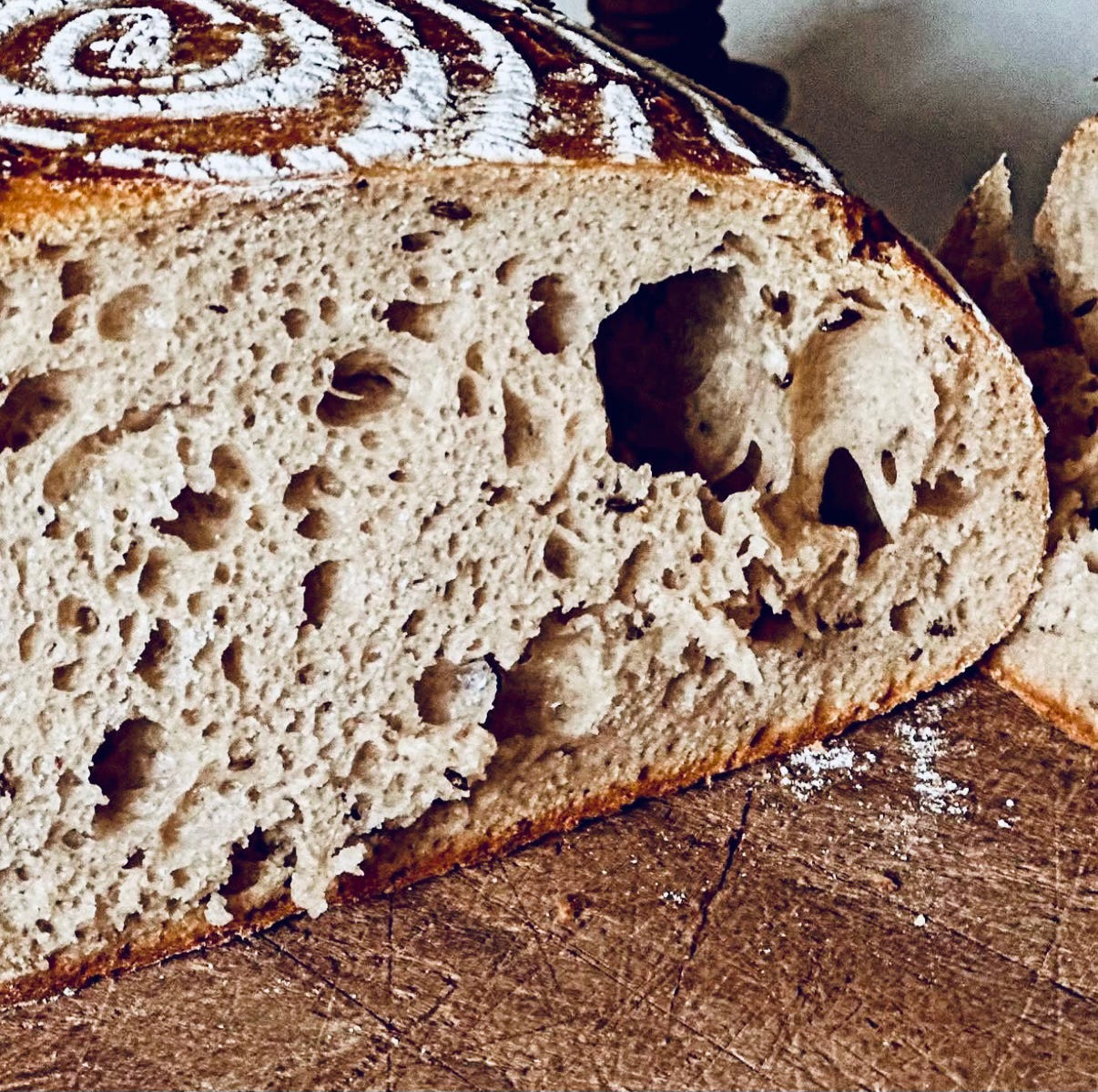
Another cold snap. Pretty typical for February at the Jersey Shore. my fingers are frozen and I’m feeling sluggish, but I know the solution: make bread. The ritual of mixing, waiting, adjusting—it’s not just a way to warm my hands. It’s how I warm up my brain for writing, too.
For me, cooking or baking is as therapeutic as it is functional. The sensory stimulation—the feeling of the flour, the rhythm of folding the dough, the scent of fermentation—quiets the mental clutter. I didn’t always understand why this process worked for me, but I’ve come to realize that my neurodivergent brain1 thrives on immersion.
Engaging multiple senses helps me think more clearly, much like how moving my body through dance unlocks ideas in a way sitting still never could.
I’ve tried meditating. I end up making lists of all the things I should be doing. Apart from dance, nothing quite organizes my brain the way sourdough bread making does.
The ingredients can’t be more humble: flour, water, and salt (you can add yeast and seeds or not). But it’s not about the ingredients, like writing, sourdough bread making is an iterative process. The first step is using a fermented or ‘soured’ dough – called starter. A container of it has a permanent home in my fridge; I ‘awaken’ it with a little more flour and water the night before I mix dough.
In the morning, I prepare a levain—an infusion of fresh flour and water that feeds the starter. As the new flour mingles with airborne yeast and the microbes from the fermented starter, the mixture begins dry and dense. But within hours, the microbes get to work,2 breaking down sugars and transforming the texture into something reminiscent of kid’s Goo or Slime. Don’t be deceived by its softness—this rich levain will give the bread both strength and depth of flavor.
In a second bowl, I pour water onto a mountain of flour (I use a combination of white, rye, and wheat) and watch it pool. When I first started making sourdough, I dove into this flour swamp with both hands, and it was like playing with peanut butter. My hands were gunked up with sticky dough. I learned I was too aggressive.
Instead, now I wade into the mix with a single finger (my technique ‘cause, why not?) swirling it through the pools of water, scraping my knuckle against the side to move reluctant flour into the fold. I learned that mixing by hand allows me to know so much about the state of the dough. If I am using a rye flour, I can feel its grittiness and find the dry spots that haven’t yet mixed with water. It’s only when all the dry parts are wet that I introduce the rest of my hand. As I mix by hand - I can “feel” when the dough is ready for the next stage.
And while my hand is busy, thoughts in my brain streamline and now I know exactly how to change up the essay I am working on.
It turns out there is another advantage to mixing by hand versus machine. Barb Alpern is a blogger and a baker with King Arthur Flour. She ran an experiment using both machine and hand mixing.3
Using machines “caused the dough to mature more quickly,” Barb told me in a call, “which meant less fermentation time was required. Unfortunately, reducing fermentation resulted in bread with less flavor and keeping quality.”
Barb’s experiment and findings fascinated me—not just because it confirmed what I’d felt instinctively, but because it reinforced a deeper truth: rushing the process, whether in baking or writing, always comes at a cost.
Any good essay needs to sit, and the same goes for sourdough. In baking and chemistry they call it autolyse. Like with the levain, the flour is absorbing the moisture and gluten bonds begin to form, which smooths out the dough. After an hour of resting, (the dough, not me) I am back at it, adding the pungent levain, some salt, and maybe caraway seeds to the mix.
Like writing, there are a number of techniques you can use to perfect your dough. One is braiding and another is slapping and folding. At first, I braid in the new ingredients, criss-crossing the dough so the ingredients combine. Next, I stretch the dough so it hangs over my counter, and slap it down, then fold it and repeat. It wasn’t until I saw a video of a big guy slapping and folding that I realized I could both ease frustrations – and make stronger fibers in the bread.
After three or four slap-and-fold sessions, my concoction is ready to be covered and set in the fridge overnight. Despite the cold, the fermented levain breaks down the flour, forming gasses, and the dough doubles or triples in size. I divide up the dough and shape it into loaves.
Even the baking itself is a process. I preheat a covered Dutch oven before adding the loaf, replace the top, and bake for 30 minutes before removing the cover for the final stretch.
All these stops and starts felt daunting when I first began. Now, I love the entire ritual. Each step is a chance to move my hands and free my mind. As the dough ferments, so do my ideas. Each pause gives me a moment to jot something down, refine a thought, or reshape a paragraph.
As I take a bite of warm bread covered with whipped ricotta and drizzled with honey, I think back to my conversation with Barb. What stayed with me most wasn’t just her knowledge, but her excitement—her willingness to keep learning. Here was someone whose skills surpassed 99.99% of bakers, yet she still approached the process with curiosity, still found more to explore. And she wasn’t just learning through reading or research—she was learning through touch, through feel, through her fingers.
“Part of what you learn with touch is that whatever you're touching is always changing - especially with dough,” she told me. “The same dough will be different from one day to the next depending on the temperature in the room and the hydration of the dough or whatever. So, you have to be able to adjust.”
Touch and adjust. (I certainly touched and adjusted this essay!)
That could be a metaphor for everything right? Whether in bread making, in writing, or in life—sometimes the best way forward is to feel our way through, let things settle, and trust the process.
What I am Reading
It’s Black History Month, it’s only fitting that I am reading The Kevin Powell Reader: Essential Writings and Conversations by Author, Activist, and Poet Kevin Powell. Tim and I heard him speak at a Juneteenth event in Red Bank, NJ. He was a voice of calm in a time that is anything but. His essays and interviews spanning 30 years, are a glimpse of America through the lens of African American voices: Dr. belle hooks, Tupac Shakur, Colin Powell, Kerry Washington, and numerous hip hop and rap artists. It’s a look at culture through a lens that has seen how whites define culture: determine which people of color are allowed to be relevant, what behavior is ugly or violent, and which actions are even considered valuable. He has learned to curb his anger and instead sees blessings. Each essay is to be savored and not rushed. t’s an awakening to read his work.
Next week I go back to fantasy and Sarah Maas’s Empire of Storms.
https://www.susupport.com/knowledge/biopharmaceutical-products/fermentation/microbial-fermentation-simply-explained#:~:text=Microbial%20fermentation%20is%20a%20biochemical,brewing%20of%20beer%20and%20wine.
What a great metaphor for the writing process. The "proofing" stage is critical and not a flop or a failure. I enjjoyed a family meal with homebaked bread this past weekend. My cousin's husband Dan has been making sourdough and brought a loaf from Roseau.
My mom liked to bake bread 🍞. When breadmakers first hit the market she wondered why anyone would want one because she loved punching the dough down. My husband and I rarely had to buy bread because she made so much and gave us loafs.
Thanks for reading out loud. 👂 🔈 🎙️