

The People of the Gods of Art: Irony, Aspiration -- or Bull?
I went looking for the Irish creation story I never learned — and found ringforts, hedge schools, hawthorn trees, and a bull whose fate could have ended two different ways, depending who's telling it.

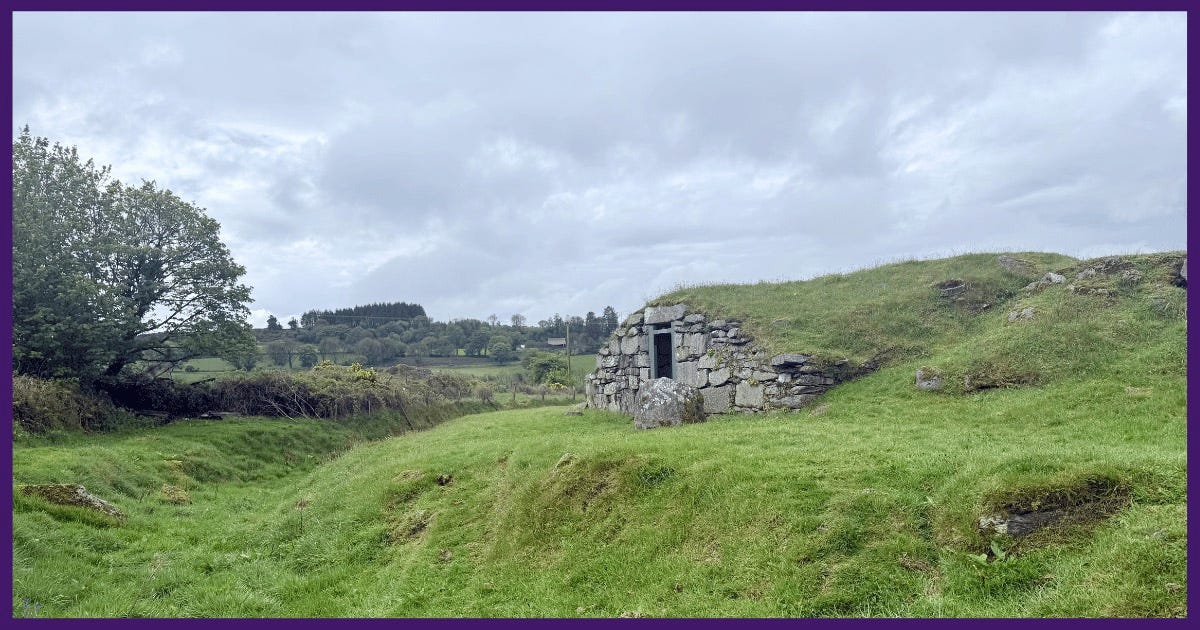
The first time I went to the Emerald Isle in 1981, I did so on a lark. I was living in London and decided to celebrate St. Patrick’s Day in Ireland. Unfortunately, there was no green beer; all the pubs were closed. It was a Holy Day of Obligation.
How did I make such a silly mistake?
“Magically delicious!” the little leprechaun promised. And for St. Patrick’s Day, Mom gave us green ankle socks with white shamrocks. At school, we received stickers of a green shamrock or four-leaf clover as a reward for reading.
I was satisfied I was fortified to be a 1960s Irish American.
It wasn’t until I began researching my family history that I realized those early childhood memories were virtually everything I knew about the Irish half of my heritage.
My Italian side came shrink-wrapped for me. Roman mythology. Leonardo da Vinci. Michelangelo. Puccini. The Renaissance. A whole civilization handed down through paintings, music, literature, and history.
Masterpieces versus merchandise.
Oh sure, the Irish had its masters – Yeats, Joyce, Behan, Lewis, Wilde. But where was the mythology? Where were the statues? The frescos?
In Rome there was the Pantheon, in Ireland there were ringforts and cashels.
There had to be an Irish equivalent of Edith Hamilton’s Mythology—something that began, “In the beginning...” Instead, every story I read seemed to begin in the middle of a conversation that had already been going on for centuries.
I wanted the clarity that I found from my Italian heritage. Something neat, easy to follow.
Since every civilization has a creation story, I set out to find Ireland’s.
There wasn’t a shortage of material: gods, ringforts, Otherworlds, sacred wells, oak trees, and fairies. But instead of a single story, I found figments and fragments.
The further I went back in Irish history, the more fractured it became. The land was occupied by tribes and chieftains, kingdoms and kings. The pagans who lived during the Bronze Age were polydeist, but also animist, which created friction.
Óengus was a powerful god with a royal court who fell in love with the human form of Cáer and wanted her for his partner. Problem was Cáer spent half the year as a swan. Óengus could not control her natural instincts. He finally accepted her force, and changed his shape to meet hers.
I couldn’t track who was in this world, the Otherworld, the four treasures, burning boats. Were they invaders, Gods, or just mischievous fairy folk?
I needed Christopher Nolan on LSD to keep up.
A good portion of the confusion has to do with the fact that the Irish – like many indigenous, had an oral culture. They didn’t write down their myths and stories, they passed them on through Brehons, Filidh, and Bards – highly educated people who spent years learning about their civilization, the gods, and the forces of nature. The purpose of laws was to keep the universe in balance and to be fair.
The judges may have meted out justice, but it was the musicians and poets who could tell a snarky tale to derail a tribal chief.
The power players were the storytellers.
The oral culture gave way to a written one when Christian monks came. By the 7th century, they were capturing these stories – although they did so around a Christian framework. Was it erasure – or just a way of trying to keep it all straight? It’s easy to argue both may be true.
The church adapted some of the gods to be saints, others to be magicians, and still others fallen angels. The Irish accepted this transformation, accepting conversion – but also keeping with many of the same traditions.
The most popular mythological tribe is the Tuatha Dé Danann, the feminine plural of Danu. Fun fact, they were originally known as Tuatha Dé -- People of God – but the monks said, hey, the Israelites are called that, so we need another name. Some say the name is about the Goddess Danu, although there is no evidence she existed (both fact and fiction). There is another theory that it stems from the Old Irish dán, meaning artistic skill — “tribe of the gods of art.”1
My western orthodox mind was annoyed that there wasn’t a canon if you will. Was it because Italy was a Catholic country that there was a throughline from Roman Gods through Christianity?
I suppose that Ireland might have had that throughline – had Henry VIII not parted with the Pope and the Catholic Church. Wanting to protect its flank from having a Catholic country off its shores, England decided to ban Catholicism – and the Irish culture. Cromwell hunted the priests and destroyed the churches and monasteries. For centuries, the institutions that protected Irish culture and might have projected them into modern day, were destroyed.
Or were they?
When Catholics were banned from education and baptisms, they learned at hedgerows; the sacred trees were now their cathedrals; the Holy wells their baptismal fonts; they danced and sang in ringforts. They didn’t need the institutions to tell them how to feel.
The institutions were gone. But the culture remained in story form.
I went back to Ireland – to County Cork where my family is from. One ancestor is from Carrigdangan. We drove to the Ringfort of Carrigdangan, an early earthen enclosure (rath).
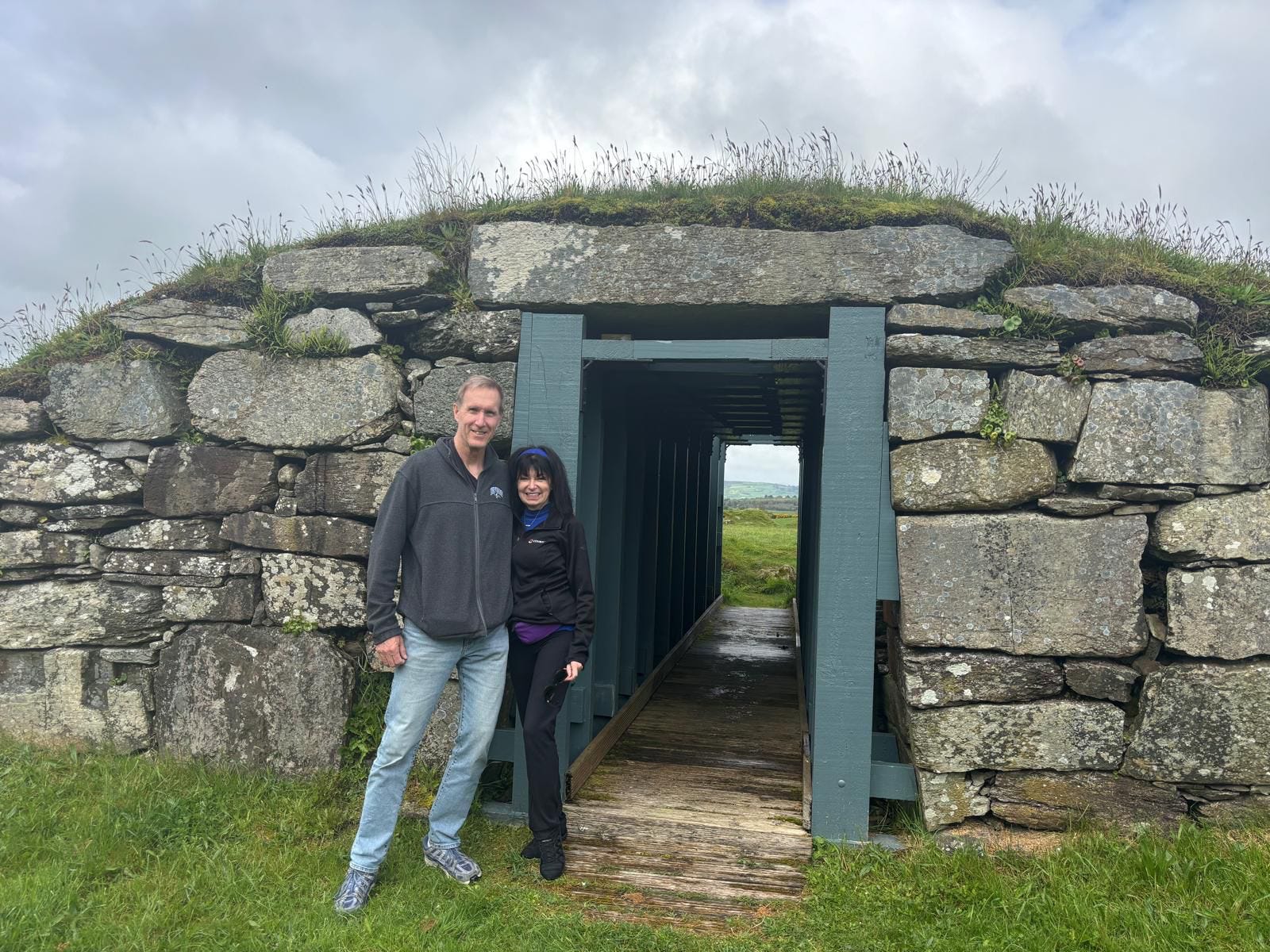
My husband Tim and I walked from the road into a culvert and then ascended to an opening made of limestone that was capped with a carpet of grass. Aside from a wooden reinforcement, it was the same as it was 1500-2000 years ago. The interior was maybe 15-20 feet long and covered with lichens. We emerged into an open enclosure.
Once inside, I turned slowly, imagining this as a perimeter for a family, their animals, garden, and home. They apparently felt safe. I wanted to feel chills while standing in this setting. But with nature all around, I simply felt calm.
Was my presence evidence that my heritage lured me here?
If no one believes in the old stories anymore, why are roads constructed around ringforts rather than through them? Why do pilgrims still visit holy wells? And what is it with hawthorns – the fairy tree?
A woman in Skibbereen told me her father insisted on planting a hawthorn near his new house to ward off bad luck.
As I was writing this an Irish transplant to the Midwest stated that the Irish were the best storytellers. It’s ingrained in us, she said.
The people of the gods of art, I thought.
I couldn’t help but think the day my Uncle Paul got married.
A bull had escaped the pasture of Uncle Leo’s neighbor, and was having a field day with all the cows. Uncle Leo was trying to capture the bull.
Uncle Warren told everyone the bull was about to charge so he had to dislodge his gun and shoot the bull to save Uncle Leo’s life. Another version was Uncle Leo had been sweet talking the bull for 15 minutes and was moving slowly to harness it. Just as Uncle Leo was about to slip the rope over the neck, a shot whizzed over his shoulder that dropped the bull.
So, which of these is true? At the end of the day, a bull was dead -- and my Uncle Paul got married.
The rest is what we want to believe.
We follow fallen and wind-blown leaves to recreate a tree.
If you’re curious about the stories hiding underneath the history we think we know, subscribe to Musings of a Storyteller. New essays arrive each week—and registration is free.
A year ago …
How amazing – and maybe a bit prescient – that a year ago I was writing about a similar topic and wishing we had an infrared light for history.
I still do.
Erasures by Omission and Commission

My husband retired last month and he announced he will do more around the house.
Final Thoughts
This essay was difficult to pull together. I tried to play it straight—and realized that didn’t do it justice.
So I leaned into the absurdity.
I think I need to do that more often.
Hope you have a wonderful weekend,
Looking for the light, always
—diane
Do you have a family story that exists in two contradictory versions, and nobody's ever settled which one's true? Would love to hear it!
https://irishmyths.com/2023/11/18/tuatha-de-danann-etymology/
You definitely inherited the Irish storytelling gene!
Pagan belief was very strong in Ireland. Some attributed the potato fungus that caused the famine to fairies being angry!
Hi, Diane,
There is more than a bit of bard in you :-)
I find, as I get older, that the culture that we are presented with (as fiat, if you will) is often remarkably poor in structure and meaning, and that even today the forces of the Christian God seem to be fighting a losing battle against this search for older truths and hidden meanings. What is Superman but a modernised version of Fionn mac Cumhaill? Iron Man but Nuada of the Silver Hands? Catwoman is Bast, Black Widow is the Morrigan (Nemain perhaps)? The Flash is Hermes, redux. I don't think the old gods are so much gone as in hiding, expressing themselves in popular culture when the paucity of the dominant paradigm finally wears too thin.